Critical systems slow down change
New products, processes, and integrations take too long because every change can trigger consequences that are difficult to assess.
MODERNATE coordinates system analysis, requirements, architecture, implementation and validation across one governed AI lifecycle—from existing software to a modernized or rebuilt system. It asks when clarification is needed. Mandatory human approvals govern critical decisions.
Software · Documentation · Verification
Check software against requirements and decisions, and retain documented verification results.
Eight protected phases create a repeatable path through discovery, design, delivery, and verification. Project extensions can add context—but never weaken the core.
Define goals, boundaries, responsibilities, and authorization.
This short product tour shows how MODERNATE connects project inputs, specialized guidance, the protected eight-phase Lifecycle Core, and governed outputs in one visual workspace.
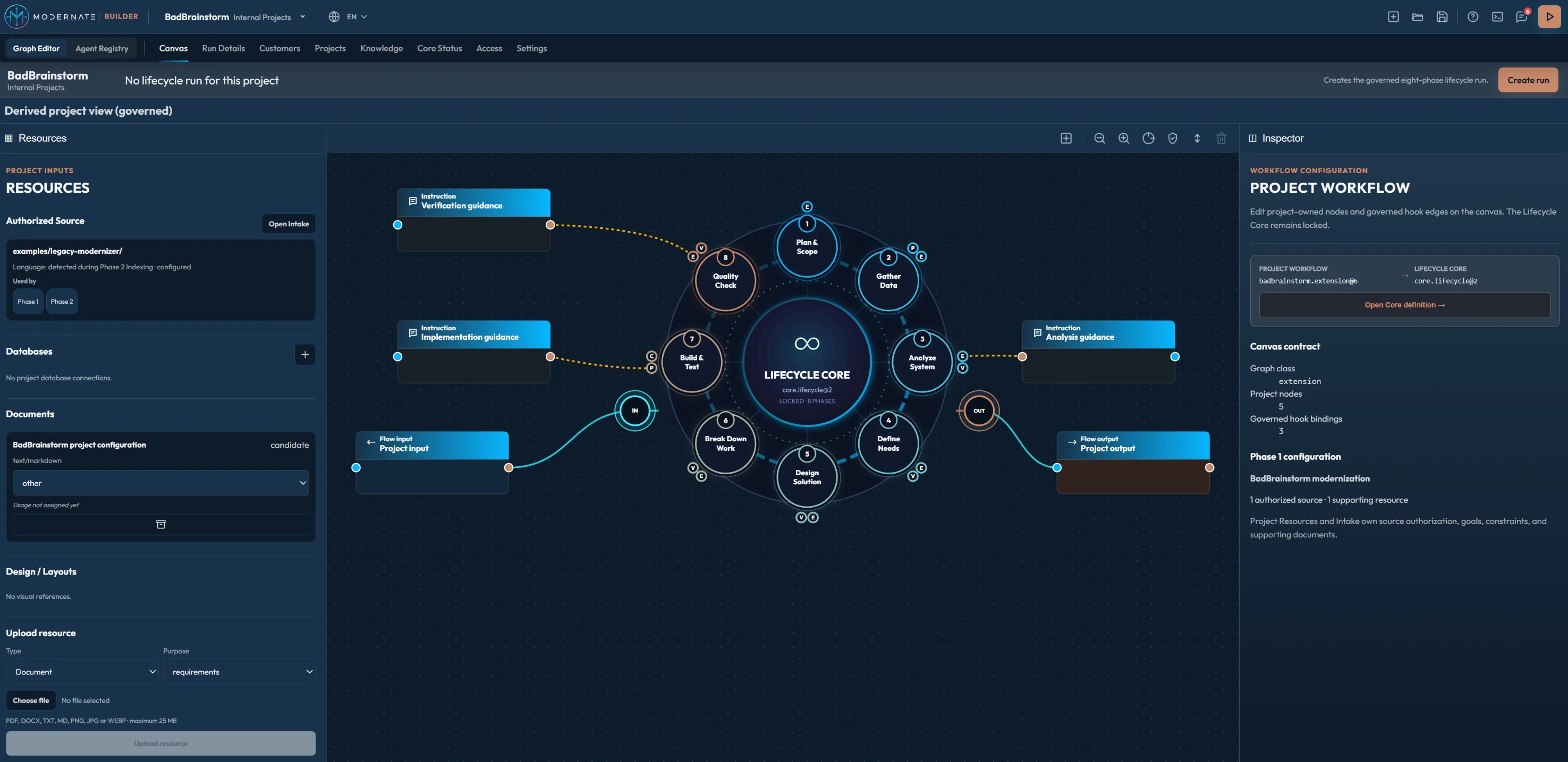
Resources, project-specific instructions, and data connections enter on the left. The protected Lifecycle Core coordinates the eight phases in the center, while project configuration and governed bindings remain visible on the right. Project context stays flexible without weakening lifecycle control.
MODERNATE is built for organizations where critical software must evolve—but uncertainty, dependencies, and governance make every material change difficult to plan.
New products, processes, and integrations take too long because every change can trigger consequences that are difficult to assess.
Knowledge is fragmented, documentation is outdated, and essential context depends on a small number of people.
Scope, cost, and timelines move as hidden risks emerge during implementation.
Automation is welcome, but decisions, architecture, and results must remain reviewable, approved, and evidenced.
Faster strategic execution and lower modernization cost
Architecture control, risk transparency, and technical traceability
Predictable scope, measurable progress, and defensible evidence
MODERNATE builds a living model of the software landscape, connects intent to implementation, and keeps every critical decision reviewable.
Structure, behavior, knowledge, and relationships stay connected as the system evolves.
Critical connections, uncertainty, and likely impact become visible before change begins.
Modernization is organized into explicit, reviewable, lower-risk increments.
Accepted requirements, architecture, implementation, and evidence remain aligned.
Protected runtime, persistence, security, governance, and orchestration.
Sealed phases, transitions, approval gates, and required artifacts.
Approved agents, tools, adapters, validators, and test runners.
Project context and stricter rules without weakening platform safeguards.
Current-state evidence stays separate from desired outcomes to reduce confirmation bias.
Material design decisions require explicit human approval tied to an exact version.
Retries, cost, resource use, and side effects remain bounded and observable.
Existing behavior is tested; intentional changes trace to an authorized requirement.
Less time rediscovering architecture and dependencies
More predictable transformation scope, effort, and risk
Traceability from business intent to verified implementation
Earlier detection of regressions and architectural drift
Reusable project knowledge instead of repeated manual analysis
Clear human accountability for material decisions
Shorter paths from system understanding to verified change.
Less repeated analysis, coordination, rework, and manual transformation effort.
Target potential for suitable modernization projects, based on the current MODERNATE delivery and cost model. Actual results depend on system condition, scope, integrations, quality requirements, and approval effort; they are not guaranteed.
Phase state, decisions, artifact fingerprints, tests, stop reasons, and cost signals remain connected—so progress is explainable, not merely reported.
sha256:9e3c…a72fTell us which system, transformation, or modernization decision you need to bring under control.
Request a MODERNATE demo